Palestine Action Arrests: 48 Detained Outside US Embassy in London Ahead of Supreme Court Appeal

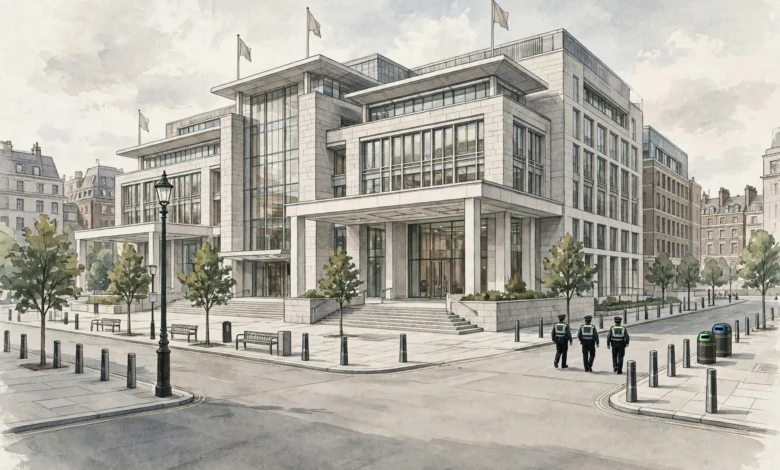
London police arrested 48 people outside the United States Embassy on Saturday, 31 October 2026, during a lunchtime demonstration in support of Palestine Action. The Metropolitan Police said in a mid-afternoon update that officers were continuing to make arrests, and that the majority of those detained were arrested for expressing support for a proscribed organisation.
The protest, organised by Defend Our Juries, took place in Nine Elms, south London, days before the UK Supreme Court hears a challenge to Palestine Action’s proscription on 4 and 5 November 2026. A parallel vigil was held outside the US Consulate in Edinburgh, near Holyrood, where demonstrators gathered in support of the group.
Palestine Action Arrests London — Quick Reference Summary
| Detail | What happened |
|---|---|
| Date and place | 31 October 2026, outside the US Embassy, Nine Elms, London; vigil outside the US Consulate, Edinburgh. |
| Arrests by mid-afternoon | 48, according to the Metropolitan Police, with arrests continuing. |
| Main reason given | Expressing support for a proscribed organisation, under the Terrorism Act. |
| Organiser | Defend Our Juries. |
| Placards reported | “I oppose genocide, I support Palestine Action”. |
| Police order in force | Section 35 dispersal order in parts of London, 8am to 11pm on 31 October 2026. |
| Next court date | UK Supreme Court hearing, 4-5 November 2026, in the case brought by co-founder Huda Ammori. |
| Proscription in force since | 5 July 2025, under the Terrorism Act 2000. |
| Arrests since the ban | Nearly 4,000 people, according to police and campaigners cited by the Associated Press. |
What officers and organisers said on the day
The Metropolitan Police began detaining people shortly after hundreds began what organisers called a “mass action” at lunchtime outside the embassy. Organisers estimated that about 400 people took part in the London rally, while other reports put the crowd at more than 100 gathered outside the building.
Commander Adam Slonecki, who led the police operation, said everyone intending to attend knew that supporting a proscribed organisation was unlawful. He said people playing a key role in organising the event, giving instructions to others or providing logistical support would very likely be committing an offence and face enforcement action.
Defend Our Juries said the Metropolitan Police were “terrified of facilitating US embarrassment”, according to reports of the protest. The group has organised a series of similar demonstrations since the ban, in which supporters hold up placards backing Palestine Action in defiance of the proscription.
Why the protest was held outside the US Embassy
The choice of location was deliberate, organisers said, because the demonstration was aimed at both the British ban and American policy. The US Embassy had issued a security advisory urging American citizens to avoid the demonstration and to exercise caution in the area.
The Metropolitan Police imposed a Section 35 dispersal order across parts of London, including the embassy grounds, between 8am and 11pm on Saturday. Police said the order followed intelligence that a group planned to attend an event and show support for a proscribed organisation.
In Edinburgh, a spokesperson for Defend Our Juries Scotland said demonstrators were sitting in peaceful vigil to show solidarity with the Palestinian people and in opposition to what the group called the “absurd ban” on Palestine Action. The Edinburgh protest was reported as a vigil rather than a mass arrest operation.
How Palestine Action came to be proscribed
Palestine Action was proscribed as a terrorist organisation under section 3 of the Terrorism Act 2000. The decision was announced to Parliament on 23 June 2025, and the implementing order came into effect on 5 July 2025, after approval by both Houses of Parliament.
The government argued that the group’s campaign of break-ins and criminal damage at defence sites, including sites linked to Israeli arms maker Elbit Systems, met the legal threshold for proscription. The group describes itself as a direct-action network targeting corporate enablers of Israel’s military operations, and it has denied that its actions amount to terrorism.
Since the ban took effect, expressing support for Palestine Action, including holding a placard backing the group, has been an offence under the Terrorism Act. Police and campaigners cited by the Associated Press put the total number of people arrested for allegedly showing support for the group at nearly 4,000.
What the Supreme Court will decide on 4 and 5 November
The Supreme Court appeal was brought by Huda Ammori, one of Palestine Action’s two co-founders. The case, listed as UKSC/2026/0099, asks whether the Home Secretary’s decision to proscribe the group was lawful.
The Divisional Court decided in Ammori’s favour on two grounds, finding the decision unlawful because the Home Secretary’s reasoning was inconsistent with her policy and because proscription was incompatible with Articles 10 and 11 of the European Convention on Human Rights. The Court of Appeal disagreed in June 2026, ruling that the Home Secretary had correctly applied her policy and that proscription was a proportionate interference with those rights.
The Supreme Court granted permission to appeal in part on 29 July 2026, on Ground 1 only, and lists the full hearing for 4 and 5 November 2026. The afternoon session on 5 November will be closed to the public and will not be livestreamed, according to the court’s listing.
The ruling will set an important precedent for how broadly the government can proscribe organisations under the Terrorism Act, and for future protest movements. Whatever the court decides, the 31 October arrests show that the ban itself remains a live and contested issue on the streets, not only in the courtroom. Poland Constitutional Tribunal crisis, cancelled G20 family photo in Atlanta, UK Supreme Court, Sky News.
Frequently asked questions
Q: How many people were arrested in London on 31 October 2026?
A: 48 people had been arrested by mid-afternoon, according to the Metropolitan Police, which said officers were continuing to make arrests.
Q: Why were they arrested?
A: The majority were arrested for expressing support for a proscribed organisation, which is an offence under the Terrorism Act since Palestine Action was proscribed in July 2025.
Q: Where did the protests take place?
A: The main demonstration was outside the US Embassy in Nine Elms, London, with a parallel vigil outside the US Consulate in Edinburgh.
Q: When is the Supreme Court hearing?
A: The hearing in Huda Ammori’s appeal is listed for 4 and 5 November 2026, with permission granted on Ground 1 only.
Q: Is Palestine Action still banned?
A: Yes. The group remains proscribed while the appeal is pending, despite the earlier High Court ruling in Ammori’s favour, which the Court of Appeal overturned.